Nova Clean · Greater Glasgow
Solar panel cleaning in Glasgow
Compatible tools and controlled access for domestic and commercial photovoltaic arrays.
Request a quoteDeciding whether a solar array would benefit from cleaning
Photographs of your array taken from an accessible place can help separate a patch of bird fouling from general weathering or shade. Tell us how many panels are involved, whether they are roof-mounted or on the ground, and whether you have the installer’s care instructions. Output figures can give context, but a change in generation has several possible causes. We can discuss cleaning the glass and leave electrical diagnosis to the installer or electrician.
Bird fouling and localised heavy deposits
Birds can perch around panel edges and rooftop plant, leaving deposits that rain does not remove. A concentrated patch on a module needs a different response from a thin film across the whole array. We plan to soften and collect the material without scratching glass or spreading it into a gutter. If birds are actively nesting beneath panels, the situation must be assessed before anything is disturbed. Cleaning old material does not by itself prevent future roosting. The owner may need a separate, properly designed proofing solution that allows ventilation and maintenance access without damaging the installation or trapping birds.
Making sense of the generation figures
If a panel-cleaning visit is prompted by a drop in generation, keep a dated note of the affected part of the array and the marks visible beforehand. A sunny afternoon after a clean and an overcast morning before it do not make a useful comparison. Look at the monitoring record over several periods with similar daylight and weather, and note any new shading. Cleaning can remove a visible deposit. If the same part of the array continues to underperform, the record gives the installer a starting point for investigating the equipment.
Access, electrical equipment and working conditions
A small domestic array in Giffnock can be high on a pitched roof, while a large commercial installation in Hillington may cover a broad flat roof with multiple obstacles. The safest access arrangement depends on height, pitch, edge protection, fragile areas and the route from the ground. We do not ask a homeowner or facilities worker to climb onto the roof for a quote. A suitable platform, scaffold or other controlled system may be required, and the cost of access can be greater than the cleaning itself. On a shared tenement or managed commercial building, the responsible person confirms permission and any roof access rules. Weather and wind may delay work when safe footing or water control is affected.
If roof cleaning is also planned, tell both teams about the panels before access is booked. Repeated deposits from a roost beneath an array may need a separate assessment for pigeon guano removal around the installation.
Protecting electrical equipment and roof fabric
Panels are electrical equipment mounted on a roof or structure that may also be fragile. A technician needs a safe route that avoids walking on modules, stressing frames or pulling cables. We discuss any manufacturer guidance and the position of isolators, connectors and inverters with the owner or responsible installer. Cleaning should not direct water into damaged seals or electrical connections. If a panel is cracked, a cable is loose or the mounting appears unstable, the work pauses pending specialist assessment. A clean glass surface cannot restore an electrical fault. Roof covering, gutters and nearby rooflights also need protection while equipment is moved to the array.
Timing around rain, frost and strong sun
Scottish weather makes a flexible schedule sensible. Rain can affect safe access, wind can move a long reach tool, and frost may make a roof or platform unsafe. Very hot glass and cold water can also be a concern, so conditions are reviewed at the time of work. Glasgow’s seasonal daylight changes power generation substantially; a comparison before and after cleaning should allow for that variation. We agree a practical weather window and explain when work must pause. A hurried visit in unsuitable conditions is not a useful way to maintain an electrical installation. Safety and surface protection come before an artificial fixed date.
Protecting occupants and property below
Water and loosened material can travel from a rooftop array to a lower terrace, shopfront, window or public route. We map those areas before work and use barriers or a suitable window where needed. A shared block may require notice to residents and coordination with a factor. We check that hoses do not create trip hazards across a walkway and that equipment is not left near an unprotected edge. Rinse water is controlled around drainage outlets and plant. At the end, the work area and immediate ground route are checked. Panel cleaning should not transfer dirt to a neighbour’s balcony or leave a business entrance wet and slippery.
When cleaning should be deferred
A cracked module, damaged mounting, exposed cable, suspect roof covering or unsafe access means cleaning should wait. We recommend that the appropriate installer, electrician or roofer assesses the concern. A cleaning visit cannot make an electrical installation safe or certify its performance. Active nesting can also change the timing and require specialist advice before disturbance. We explain the reason for a pause rather than improvising around a hazard. Once the issue is resolved, a suitable method can be agreed for the remaining surface. This protects people, equipment and the roof while avoiding work that would have to be repeated.
Cleaning the glass, frames and edges
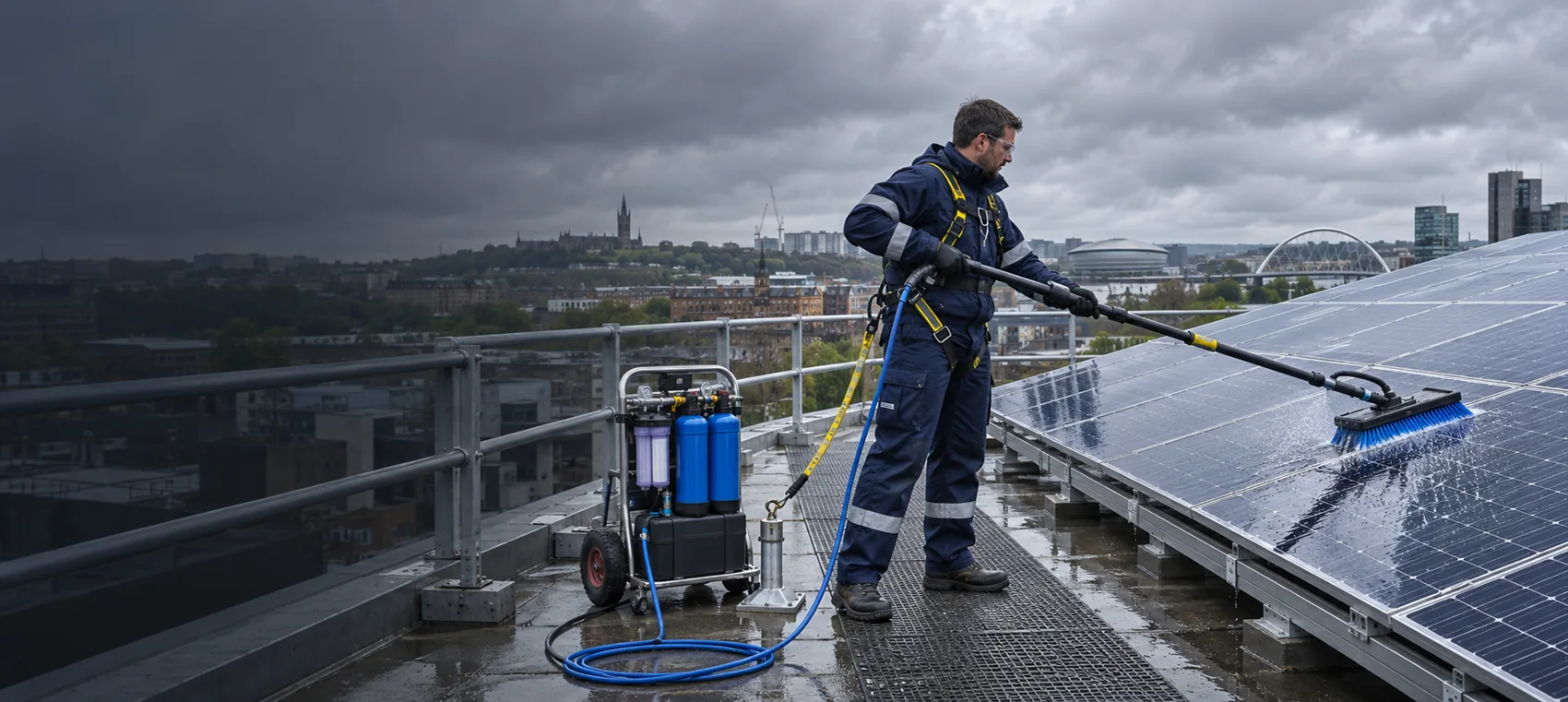
A soft brush and suitable purified water system can remove many ordinary deposits without leaving mineral spotting, but equipment choice depends on the panels and access. We avoid abrasive pads, hard scraping, harsh chemicals and high pressure jets that could damage glass coatings, seals or frames. A stubborn bird deposit may need careful soaking and controlled removal rather than more force. Manufacturer instructions take precedence over a generic cleaning habit. We consider where rinse water will flow and whether it may mark a facade or enter sensitive equipment below. A small test can help where an older array has persistent residue or an unknown surface treatment.
Frames, edges and drainage channels
Dirt can collect at lower panel edges and in the spaces between frames, but those parts may also contain seals and drainage paths. We clean reachable exposed areas gently and avoid prying at a frame or forcing water beneath a module. Loose leaves near an array may be removed as part of an agreed scope, with care not to push them into a gutter. If a mounting clamp looks loose or a frame is visibly damaged, the observation is referred to the installer. The cleaning team does not loosen a panel to reach hidden debris. A clear boundary between cleaning and system maintenance protects the warranty and the building fabric.
A methodical cleaning sequence
The team checks the agreed access, weather, roof route and any reported damage before moving equipment. The panel surface is treated with compatible soft tools and controlled water, working across defined sections without loading the frames. Heavier deposits receive careful local attention rather than broad force. We manage runoff, check for remaining marks and record any panel that was not safely reachable. The handover notes the work completed and any visible concern that requires an installer. We do not disconnect electrical components, change inverter settings or promise that every historic mark can be removed. The owner can use the date and location record alongside their own maintenance information.
Domestic panels, commercial arrays and other roof work
Homeowners in Bearsden, Milngavie, Newton Mearns, Clarkston and Glasgow suburbs may have arrays placed at different angles and roof heights. Shaded slopes near trees can collect pollen and leaf debris, while an exposed roof may stay cleaner. We ask when the system was installed, whether the owner has care instructions and which panels can be seen safely. Some roofs cannot be cleaned economically without substantial access equipment, and we explain that clearly. We can discuss a panel clean alongside a roof or gutter assessment only when the tasks and safety arrangements are explicitly scoped. We do not alter the wiring or settings as part of the cleaning.
Commercial arrays and facilities coordination
A warehouse, office or institutional roof may contain hundreds of modules, rooflights, HVAC equipment and designated walkways. The facilities manager can provide drawings, access procedures and operational restrictions. We plan sections so technicians do not cross fragile areas or interfere with live plant. Water supply, hose routes, drainage and protection of people below are agreed in advance. A repeat cleaning programme should be based on observed soiling and maintenance data, not a blanket promise of a fixed output gain. The handover can document which strings or roof zones were treated, any module that was not safely accessible and visible damage to be referred to an installer.
Solar panels beside other roof work
A roof with moss growth and solar panels may need a sequence rather than one undifferentiated wash. Loose material on the covering could be displaced onto clean glass if the roof is treated afterward. We discuss whether roof cleaning, gutter clearance or panel cleaning is requested and in what order they should occur. Each activity has different tools and risks. A large array can restrict access to the covering beneath it, which may require an installer for a separate repair or inspection. The quotation states the surfaces included and any zone that cannot be reached safely. We avoid washing a defective roof simply because the panels themselves need attention.
Working with installers and building managers
A panel installer or building manager may hold details that make cleaning safer and more effective: module care instructions, roof drawings, designated access routes and records of previous damage. We ask for that information when it is available, while recognising that an older domestic installation may have limited paperwork. The owner should know who can authorise roof access and whether a warranty imposes a specific method. If an electrical inspection is planned, the cleaning can be scheduled so that the two tasks complement each other without either trade claiming to perform the other’s work. Clear records of the treated sections help the responsible specialist interpret any later performance concern.
Costs and maintenance across Greater Glasgow
Tell us the address, number of panels or approximate array size, roof type, height, angle and visible deposits. Safe photographs from the ground, a loft window or an existing approved access point are useful, but nobody should step onto a roof solely to collect them. Mention any manufacturer care instructions, cracked glass, loose cable or active bird activity. For a commercial roof, share access rules and a plan if available. We can then discuss whether a survey is needed, what access equipment may be suitable and whether the work can be combined with another maintenance visit. A clear scope avoids a low estimate that excludes essential safety arrangements.
Costs and realistic maintenance intervals
Price depends on the number and layout of modules, roof height, access equipment, extent of soiling and whether a safe water route exists. A small domestic installation high above a conservatory may be more complex than a larger low roof array with a protected walkway. The interval for future cleaning should follow observed deposits, roof setting, bird activity and the owner’s maintenance data. We do not prescribe the same frequency for a shaded home in East Dunbartonshire and a commercial roof in Paisley. A service should have a clear reason and a result the client can inspect. Any optional roof or gutter work is identified separately.
Greater Glasgow coverage and contact
We discuss solar panel cleaning in Glasgow, Paisley, Bearsden, Clydebank, Newton Mearns, Milngavie, Renfrew, Greenock and surrounding areas of West Dunbartonshire, East Dunbartonshire, Renfrewshire, East Renfrewshire and Inverclyde. A roof’s access and condition matter more than its postcode alone. Call Nova Clean Glasgow on 0845 52 805 20 or email