Nova Clean · Greater Glasgow
Pigeon guano removal in Glasgow
Controlled collection and careful cleaning for ledges, roofs, plant areas and shared buildings.
Request a quoteAssessing pigeon fouling and access
A strip of pigeon fouling on a balcony rail and a sheltered plant room used by roosting birds need different arrangements. When you contact us, describe where the deposits are, who uses the space and whether it can be isolated during the visit. A factor arranging work at a Glasgow tenement may also need to coordinate access with residents below. Photographs you already have are helpful. You can request an assessment without disturbing the deposits.
A proportionate approach to health precautions
Bird fouling can present a hygiene concern, especially where material accumulates near food handling, air intakes or frequently used entrances. The precise risk depends on quantity, age, location and the people who may be exposed. We do not diagnose illness or suggest that every small mark requires a major decontamination. Instead, we assess the work area, choose controls for the exposure, and explain why a method is suitable. Anyone with a medical concern should seek advice from an appropriate health professional. Property managers can reduce unnecessary contact by keeping an affected location out of use until the material has been assessed and removed by a competent team.
When birds or nests are active
An active nest or an occupied roost changes the plan. Work should pause while the situation is checked against the protections that apply to wild birds and the specific circumstances. We do not remove or disturb an active nest on the assumption that cleaning permission covers it. The building owner or manager may need specialist ecological advice and a suitable timing plan. A practical survey distinguishes old debris that can be removed from an area that is still being used by birds. Avoiding unnecessary disturbance also helps the team work safely and prevents repeated work before the access issue is resolved.
Balconies, plant equipment and food premises
Glasgow sandstone, painted masonry, metal railings and modern cladding respond differently to cleaning. Droppings can be acidic and may leave a mark after the bulk material is removed, especially on porous stone or a weathered paint film. We identify the surface, test a discreet area where appropriate and avoid aggressive action that would remove sound material. Balconies in the West End may contain planters, timber decking and furnishings that need separate handling. A ledge above a shopfront can require protection for glazing and signs below. The scope distinguishes removal of fouling from restoration of staining, repointing or repainting, which may need a different specialist.
Once the fouling has been dealt with, the remaining marks may belong to the underlying finish. We can distinguish routine balcony and terrace cleaning from work on a sandstone façade when setting out the scope.
Roofs, gutters and plant installations
Birds often settle around parapets, roof plant, solar arrays, gutters and sheltered recesses. Material in a gutter can contribute to blockage, while nests close to ventilation may affect building maintenance. We map the routes by which debris could enter drains or be carried by runoff. Roof access is planned with the same care as any work at height, including fragile rooflights and equipment that must not be disturbed. A maintenance record may identify a leak or damaged grille that should be repaired after cleaning. We do not touch live electrical or mechanical installations unless a responsible specialist has made them safe and defined the work.
Commercial kitchens and food premises
A food business needs a cleaning plan that respects its operating hours, food storage and established hygiene procedures. Fouling at a rear service yard, extractor housing or delivery entrance should be isolated from food preparation and cleaned with controlled waste handling. We coordinate with the manager on access, temporary closure of an area and any equipment that should be switched off by authorised staff. Cleaning bird deposits is not a substitute for pest management, structural repairs or the business’s routine food safety controls. The handover can record the areas treated and any condition that may allow birds to return. A café in Partick and a large distribution kitchen in Paisley will have different access and scheduling requirements.
Planning a controlled clean in an occupied building
Arranging access through a shared close
In a Glasgow tenement, the affected ledge might belong to one flat while the route to it passes through the common close or a neighbour’s home. The factor or authorised resident can identify who holds each key and agree a time with the households concerned. The notice to residents should say which doorway or part of the back court will be in use, for how long and whom to contact about access. If a resident relies on the usual entrance, agree an accessible route in advance. Photographs taken from a position residents already use can help identify the location without disturbing the deposits.
Keeping dust and dried material contained
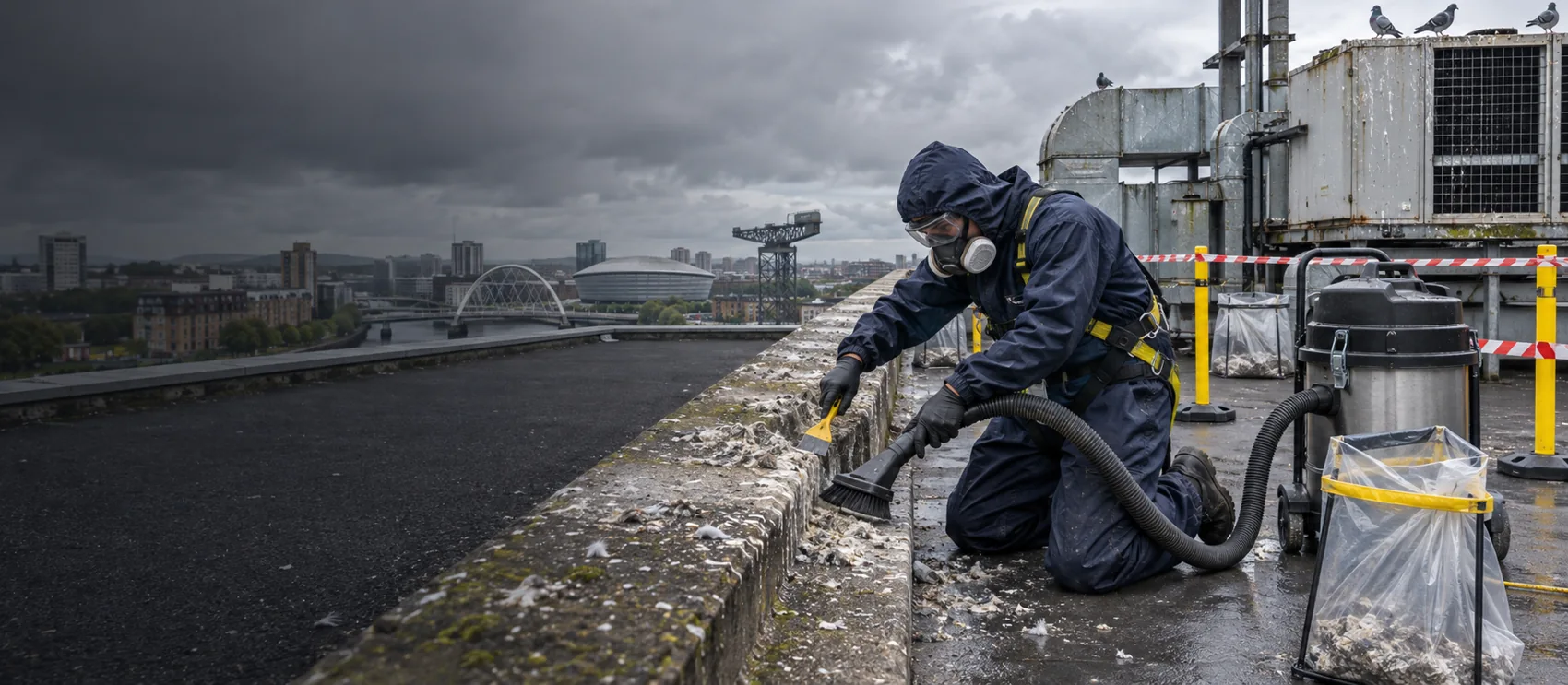
Dried bird fouling can become airborne when it is brushed, swept or blasted. That makes dry sweeping and uncontrolled pressure washing unsuitable ways to approach a heavily affected area. We plan a method that contains the material at source, with suitable protective equipment and controlled collection. Dampening or specialist vacuum extraction may be appropriate according to the substrate and exposure. The aim is to avoid carrying particles into occupied rooms, ventilation inlets, shared stairs or neighbouring premises. A public pavement or communal courtyard may need barriers and a work window agreed with the building manager. People should not be asked to pass beneath an active cleaning area.
Choosing equipment for the amount of fouling
A light, recent deposit on a washable exterior surface may require a smaller task than a thick, dry accumulation in a sheltered loft. The collection equipment, protective clothing, access system and time required follow the actual condition. We avoid declaring a fixed price from a photograph that does not show the whole area. A trial clean may reveal staining beneath the material or damage to the underlying coating. Where a pressure controlled rinse is appropriate, runoff must be captured or managed so that contamination is not simply moved to a lower level. The team checks corners, fixings, drainage points and adjacent surfaces as part of the agreed scope.
The sequence during a controlled clean
The team confirms the authorised work area, access and barriers before moving equipment. Loose material is collected by a method selected to limit airborne spread and protect the substrate. Residue is then cleaned with products suitable for the surface and conditions, taking care around drains, glazing and equipment. Waste is contained, the immediate area checked and barriers removed only when it is safe to reopen. A photograph from a comparable viewpoint can help demonstrate the result. A stain that remains because it has penetrated porous stone is recorded rather than hidden behind a claim of complete restoration.
Waste removal, handover and prevention
Collected material, used protective items and contaminated consumables need an appropriate handling route. The classification and disposal method depend on the circumstances and local arrangements, so the quote should describe what is included rather than promise a universal waste category. Bags or containers are secured before being moved through a shared building. We check that loose residue has not been left at the base of a wall or in a gutter. The handover can include safe photographs and a record of the locations treated. If the area remains accessible to birds, the client should understand that cleaning alone does not prevent a new accumulation.
Prevention after the deposits are removed
Proofing measures can reduce future roosting, but their design depends on the building and must not trap birds or damage valuable fabric. A poorly placed spike or net can create a new maintenance problem or leave a hidden pocket where debris collects. We discuss the affected ledge, access needed for future inspection and whether a separate competent installer should specify a barrier. Food sources, open waste and building defects can also influence bird activity. Cleaning and proofing should be priced separately when the scope differs. A maintenance plan for a retail canopy or plant room may be more useful than a single promise that birds will never return.
Limits of a cleaning service
Cleaning does not repair a corroded fixing, damaged roof covering, leaking gutter or broken bird barrier. It cannot establish the condition of a concealed loft or duct without access and a defined inspection. We flag visible concerns so the owner can arrange the relevant trade. If a surface is fragile or a product could cause more harm than benefit, we may propose a trial, an alternative method or no cleaning until repair. These limits are important in heritage fabric and occupied buildings. A precise handover gives the manager useful information for maintenance without pretending that every issue can be solved in one visit.
Prices and coverage across Greater Glasgow
Tell us the property type, the affected surfaces, approximate height, amount of material and whether people pass beneath the area. Mention any roof plant, solar panels, food handling, open ventilation or known active nesting. Photographs taken safely from ground level are useful; do not climb to collect a sample. We ask who can authorise access and whether a factor or business operator needs to approve a work window. A detailed quote can then identify the method, access, containment, disposal and exclusions. If the contamination extends inside a void or ventilation system, that should be described separately from the exterior ledge.
Costs and practical timing
The largest cost factors are often access and containment rather than the visible size of a stain. A high ledge above a public route may require a platform, barriers and a work window, while a low sheltered yard can be approached differently. Thick deposits take longer to collect and may reveal damaged paint or stone that cannot be restored by cleaning alone. We discuss what equipment can be brought through the property, how water and power can be provided and where collected material will leave the building. The quotation should distinguish an initial clean, any follow-up treatment and optional proofing. Urgent access is sometimes possible, but a realistic schedule must allow for authorisation, weather and the safe management of people nearby. A property manager can reduce delays by identifying the correct decision maker and sharing any roof or access plans already available.
Inverclyde, Renfrewshire and exposed settings
Coastal exposure around Greenock and Inverclyde can affect both bird activity and the condition of metal fixings or painted surfaces. In Paisley and Renfrew, older masonry courts and commercial yards may have sheltered perches. Clydebank, Bearsden and Milngavie bring a different mix of residential blocks, schools and business premises. The local setting matters more than repeating a generic method. We consider wind during access, runoff near entrances and whether cleaning can take place during a quiet period. The team’s scope is based on the building condition and affected surfaces, with the postcode used to plan logistics rather than to make assumptions about hygiene.
Coverage across Greater Glasgow
Nova Clean discusses pigeon fouling work in Glasgow, Paisley, Clydebank, Bearsden, Newton Mearns, Milngavie, Renfrew, Greenock and surrounding parts of West Dunbartonshire, East Dunbartonshire, Renfrewshire, East Renfrewshire and Inverclyde. The relevant team and access method depend on the building, height and contamination. A central Glasgow ledge above a pavement may require more planning than a larger low level yard outside the city. We look at the individual property rather than applying a standard price to every address. A clear initial description helps us decide whether a visit or further photographs are needed.
Contact Nova Clean Glasgow
For pigeon droppings cleaning in Greater Glasgow, call 0845 52 805 20 or write to